

ICC Men’s Cricket World Cup Winners List and Prize Money: The Ultimate Historic Guide
Here is guide of Cricket world cup winners
The ICC Men’s Cricket World Cup represents the ultimate peak of one-day international cricket. Every four years, global powerhouses clash in a grueling battle for legacy, honor, and financial rewards. For cricket enthusiasts tracking the sport’s history or looking for definitive tournament statistics, having an accurate, centralized resource is essential.
This comprehensive guide delivers the complete men’s Cricket world cup winners list from the tournament’s inception in 1975 to the historic modern editions. We also break down how the tournament prize money has evolved from humble structural certificates to multi-million dollar payouts, alongside answering the most common questions about the competition’s history.
The Ultimate Men’s Cricket World Cup Winners List (1975–2023)
The journey of the One Day International (ODI) World Cup mirrors the physical evolution of the sport itself. The tournament transitioned from 60-over matches played in traditional white clothing with a red ball to the fast-paced, 50-over, floodlit spectacles we watch today.
Understanding the distribution of world titles reveals historical eras of absolute dominance and unexpected, fairytale underdog triumphs. The following complete tournament breakdown tracks every single edition of the elite competition:
| Year | Host Nation(s) | Winner | Runner-Up | |
|---|---|---|---|---|
| 1975 | England | West Indies | Australia | |
| 1979 | England | West Indies | England | |
| 1983 | England | India | West Indies | |
| 1987 | India & Pakistan | Australia | England | |
| 1992 | Australia & New Zealand | Pakistan | England | |
| 1996 | India, Pakistan & Sri Lanka | Sri Lanka | Australia | |
| 1999 | England & Wales | Australia | Pakistan | |
| 2003 | South Africa, Zimbabwe & Kenya | Australia | India | |
| 2007 | West Indies | Australia | Sri Lanka | |
| 2011 | India, Bangladesh & Sri Lanka | India | Sri Lanka | |
| 2015 | Australia & New Zealand | Australia | New Zealand | |
| 2019 | England & Wales | England | New Zealand | |
| 2023 | India | Australia | India |
Breakdown of Total World Cup Titles by Country
When evaluating long-term dominance in the men’s Cricket world cup, one nation stands far above the rest. Australia’s relentless cricketing structure has helped them capture six separate world titles across four distinct decades.
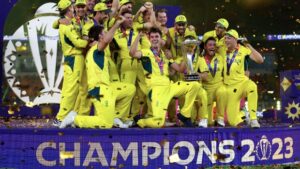
Here is how the world championship titles are shared across the international cricketing landscape:
- Australia (6 Titles): 1987, 1999, 2003, 2007, 2015, 2023
- India (2 Titles): 1983, 2011
- West Indies (2 Titles): 1975, 1979
- Pakistan (1 Title): 1992
- Sri Lanka (1 Title): 1996
- England (1 Title): 2019
Did You Know? New Zealand holds the agonizing record for the most appearances in a men’s Cricket world cup final without ever lifting the trophy, finishing as runners-up in both 2015 and 2019.
Evolution of the Cricket World Cup Prize Money
The financial side of international cricket has grown exponentially alongside its global television viewership. In the early editions of the tournament—sponsored by Prudential—the reward money was minimal, focused primarily on the cultural prestige of hoisting the cup.
By the time the tournament returned to India for the massive 2023 iteration, the International Cricket Council (ICC) put forward an overall US$10 million total prize pool.
The 2023 Prize Money Distribution Model
To understand how modern cricket rewards performance at elite levels, analyze the tier-by-tier payout structure from the most recent 50-over event:
- Tournament Champions (Australia): US$4,000,000
- Runners-Up (India): US$2,000,000
- Losing Semi-Finalists (South Africa & New Zealand): US$800,000 each
- Group Stage Elimination Base Pay (6 Teams): US$100,000 each
- Group Stage Match Win Bonus: US$40,000 per victory
This financial progression acts as a foundational benchmark for international tournaments. The ICC has committed to parity across major tournaments, moving forward with equal baseline payouts for both men’s and women’s world events.
Additionally, individual national boards frequently distribute independent bonuses to players following successful campaigns. For instance, following historic tournament runs, boards like the Board of Control for Cricket in India (BCCI) routinely announce multi-million dollar domestic cash rewards for the squad and coaching staff, separate from the baseline ICC payouts.
Defining Eras in World Cup History
Analyzing the men’s Cricket world cup winners list highlights three distinct eras of cricket strategy and geographical dominance.
1. The West Indian Powerhouse Era (1975–1979)
Led by the towering leadership of Clive Lloyd and powered by an unmatched four-pronged fast-bowling battery, the West Indies dominated the initial editions. Their aggressive, fearless style established how limited-overs cricket should be approached. Their reign finally shattered in 1983 when Kapil Dev’s underdog Indian squad successfully defended a modest 183 runs at Lord’s, a historic moment that fundamentally shifted the financial and cultural center of gravity for cricket toward South Asia.
2. The Unstoppable Australian Treble (1999–2007)
Between 1999 and 2007, Australia achieved a legendary feat by winning three consecutive World Cups without losing a single tournament match along the way. Spearheaded by captains Steve Waugh and Ricky Ponting, and featuring all-time greats like Shane Warne, Glenn McGrath, and Adam Gilchrist, this squad is widely considered the most dominant collection of talent ever assembled in cricket history.
3. The Home Team Advantage Trend (2011–2019)
For over three decades, a strange curse dictated that no host nation could win the tournament on their own soil. That narrative changed completely in 2011 when MS Dhoni hit a historic winning six in Mumbai, securing India’s second title. This sparked a dominant trend where the home environment proved decisive, followed by Australia winning in Melbourne in 2015, and England claiming their maiden title at Lord’s in 2019. Australia broke this home-team streak in 2023 by silencing a massive crowd in Ahmedabad to defeat host-nation India.
Frequently Asked Questions
Which team has won the most men’s Cricket world cups?
Australia is the most successful team in the history of the tournament, having won the championship 6 times (1987, 1999, 2003, 2007, 2015, and 2023). They have also finished as runners-up twice.
What is the prize money for winning the ICC Men’s Cricket World Cup?
In the most recent 50-over ODI format iteration, the winning team received US$4 million out of a total US$10 million tournament pool. The runner-up took home US$2 million, with extra bonuses awarded for individual group-stage match wins.
Who has scored the most total runs in World Cup history?
India’s Sachin Tendulkar holds the record for the most runs in the competition’s history, accumulating 2,278 runs across six tournament appearances from 1992 to 2011.
How often is the men’s Cricket world cup held?
The tournament is organized by the International Cricket Council (ICC) and takes place once every four years.
Strategic Takeaways for Cricket Fans
The legacy of the World Cup shows that tactical innovation, handling immense pressure, and adapting to varying pitch conditions dictate who takes home the multi-million dollar prize. Whether it is the historic dominance of Australia or the resurgence of South Asian cricket hubs, tracking these trends gives fans deep insight into how the modern game continues to change.
To explore deeper analysis on team tactical strategies, historical player rankings, or detailed overviews of upcoming international cricket matches, browse our comprehensive tactical archives and seasonal guides.