

How Does DRS Work in Cricket? The Ultimate Fan Guide
Few things match the sudden tension of a cricket match when a fielding captain or an opening batsman raises their hands to form a “T” sign. The stadium holds its breath, the on-field umpires pause, and the third umpire takes control of the broadcast room.
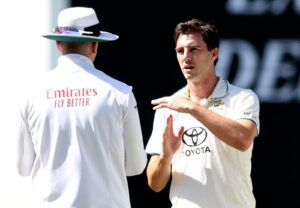
If you have ever found yourself yelling at the television screen during an intense leg-before-wicket (LBW) shout, you have likely wondered: how does drs work in cricket?
The drs system in cricket has completely transformed the modern game. It turned agonizing human errors into data-driven, highly accurate spectacles. Whether you are a casual fan tuning in for the ICC World Test Championship or an analytical enthusiast tracking every over, understanding the technology and protocols behind a review is essential. This comprehensive guide breaks down the technology, rules, history, and strategic nuances of reviews across formats.
Table of Contents
- What is the Full Form of DRS in Cricket?
- When Was DRS Introduced in Cricket? A Brief History
- The Core Technology Behind the DRS System in Cricket
- Step-by-Step: How Does DRS Work in Cricket During a Review?
- How Many DRS in Test Cricket, ODIs, and T20Is?
- Understanding Umpire’s Call: The Ultimate Fan Confusion
- Frequently Asked Questions (FAQs)
What is the Full Form of DRS in Cricket?
Let’s start with the absolute basics. What is the full form of drs in cricket?
The full form of drs in cricket stands for the Decision Review System.
It is a technology-based protocol used to assist the on-field umpires in making accurate decisions for contentious dismissals, such as LBWs and catches.
Before the advent of drs in cricket, an umpire’s mistake was final. A batsman could be wrongly sent back to the pavilion by a flawed caught-behind decision, or a bowler could be denied a clear wicket due to a masked angle. The system was engineered not to replace human umpires, but to eliminate what the International Cricket Council (ICC) refers to as the “egregious error”—the blatant mistake that could alter the outcome of an entire international match.
When Was DRS Introduced in Cricket? A Brief History
To truly understand how far the game has come, we have to look back at when was drs introduced in cricket.
The concept was born out of a desire for fairness, pioneered heavily by the innovative minds looking to integrate modern computing into sports broadcasting.
- The Inventor: If you are curious about who invented drs in cricket, credit is largely given to Senaka Weeraratna, a Sri Lankan lawyer. In the late 1990s, Weeraratna conceived the core idea of allowing players to formally challenge an umpire’s decision using television replays. His concept eventually caught the attention of cricket boards and evolved into the formal system we see today.
- The Test Debut: The system was officially introduced in an international Test match in November 2008, during a series between India and Sri Lanka. The very first player to be given out under this official trial system was the legendary Indian batsman Virender Sehwag, who was trapped LBW by Sri Lankan mystery spinner Muttiah Muralitharan.
- The Evolution: Initially met with heavy skepticism—particularly by the Board of Control for Cricket in India (BCCI), who questioned the mathematical accuracy of ball-tracking software—the system underwent rigorous independent testing by institutions like MIT. By 2011, it made its debut in One Day Internationals (ODIs) during the ICC Cricket World Cup and has since become mandatory for all major international fixtures and elite domestic leagues like the Indian Premier League (IPL).
The Core Technology Behind the DRS System in Cricket
When a player signals for a review, the third umpire relies on an array of advanced tracking instruments provided by independent tech companies. To understand how the drs system in cricket works, you must get familiar with its three core pillars:
1. UltraEdge / Snickometer (Audio Tracking)
To determine if a ball grazed the bat before hitting the pad or landing in the wicketkeeper’s gloves, umpires use directional microphones. UltraEdge uses a microphone placed in the stumps to capture sound waves. This sound is perfectly synchronized with a high-speed camera. If a sharp audio spike matches the exact microsecond the ball passes the bat, it confirms an edge. A flat audio line indicates no contact with the bat.
2. Hot Spot (Infrared Imaging)
Hot Spot utilizes unique thermal imaging infrared cameras positioned at opposite ends of the stadium. When a cricket ball strikes a surface—be it the willow of the bat, a protective pad, or a batsman’s glove—friction creates a microscopic amount of heat. This heat shows up on the third umpire’s screen as a bright white spot. It offers clear, visual proof of an edge or pad impact.
3. Hawk-Eye (Ball Tracking Technology)
For LBW decisions, the third umpire needs to know where the ball would have gone if the batsman’s legs hadn’t gotten in the way. Hawk-Eye deploys six or more high-speed tracking cameras positioned around the ground to map the path of the ball from the bowler’s release point to its bounce and subsequent trajectory. The software calculates a highly accurate, mathematically projected path to determine if the ball would have gone on to hit the stumps.
Step-by-Step: How Does DRS Work in Cricket During a Review?
The review process is highly systematic, designed to check every possible point of failure in order. Here is the exact checklist the third umpire follows during a player review for an LBW:
[On-field Call] ➔ [Check Fair Delivery (No-Ball)] ➔ [Check Bat Involvement (UltraEdge/Hot Spot)] ➔ [Track Ball Path (Hawk-Eye)] ➔ [Final Decision]
- The Challenge: A player has exactly 15 seconds from the moment a ball becomes dead to signal a review by forming a “T” with their forearms.
- The Fair Delivery Check: Before looking at the dismissal itself, the third umpire requests television replays of the bowler’s front foot to ensure they have not overstepped. If it is a no-ball, the review ends immediately, and the batsman is ruled safe.
- Checking for an Edge: The third umpire looks at Hot Spot or UltraEdge. If the ball clearly hit the bat first before striking the pad, the batsman cannot be given out LBW, and the on-field decision is overturned (or upheld, if the umpire had originally said not out).
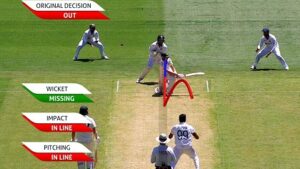
- The Ball-Tracking Visual: If there is no bat involved, the third umpire switches to Hawk-Eye. The ball-tracking sequence is broken into three critical assessment zones:
- Pitching: Did the ball land in line with the stumps, on the off-side, or down the leg-side? (A ball pitching down the leg-side cannot result in a legal LBW dismissal).
- Impact: Where did the ball make physical contact with the batsman’s protective pad? Was it directly in front of the stumps?
- Wickets: A virtual projection shows whether the ball would have crashed into the stumps, trimmed the bails, or missed them entirely.
How Many DRS in Test Cricket, ODIs, and T20Is?
The rules governing the allocation of reviews have shifted over time to ensure teams do not abuse the system for tactical time-wasting. According to the latest ICC playing conditions, here is exactly how many drs in test cricket and limited-overs cricket are permitted per team:
| Format | Unsuccessful Reviews Allowed | Reset/Innings Details |
|---|---|---|
| Test Cricket | 3 reviews per innings | Reviews do not reset after 80 overs. If a review is successful or results in an “Umpire’s Call,” the team retains the review allocation. |
| One Day Internationals (ODIs) | 2 reviews per innings | Standard across men’s and women’s international ODI matches. |
| T20 Internationals (T20Is) | 2 reviews per innings | Maximizes fair play in fast-paced short formats. |
(Note: For fans looking to read deeper into specific match situations, you can check out our comprehensive guide on international playing conditions on official sports governance portals like the ICC Official Rules, which details fine margins for weather-interrupted games.)
Read more:
Understanding Umpire’s Call: The Ultimate Fan Confusion
You cannot talk about the drs system in cricket without addressing its most controversial mechanism: Umpire’s Call.
This rule often leaves fans frustrated. It occurs when the ball-tracking software shows that a delivery is just barely clipping the edge of the stumps or the outer line of the impact zone. Because ball tracking relies on a predictive trajectory with a tiny margin of error, the technology acknowledges that it cannot be 100% absolute on millimeter-thin margins.
Therefore, if less than 50% of the ball is projected to hit the stumps (or less than 50% is inside the impact zone), the tracking software yields back control to the on-field official.
- If the on-field umpire originally gave the batsman OUT, the tracking display will stay red, and the batsman is sent off.
- If the on-field umpire originally gave it NOT OUT, the display will stay green, and the batsman stays at the crease.
The Saving Grace for Teams: If a review returns as an Umpire’s Call, the reviewing team does not lose their review allocation. It is treated as a statistical tie—the system recognizes your review was completely logical, even if it wasn’t enough to overturn human judgment.
Frequently Asked Questions (FAQs)
What happens if the 15-second timer runs out before a captain calls for a DRS review?
If the 15-second visual countdown clock on the broadcast screen reaches zero before a captain or batsman clearly makes the “T” signal, the right to review is forfeited. The on-field umpire will refuse any late requests to ensure the game maintains its natural pace.
Can the third umpire intervene without a player initiating a DRS review?
Yes, but only for specific, non-judgmental tracking scenarios. The third umpire routinely checks for front-foot no-balls, boundary line saves, clear run-outs, stumpings, and unfairly caught low-catches to ensure high accuracy, even if the players don’t formally call for a review.
Does a team lose its review if the decision is reversed?
No. If your review successfully overturns the on-field umpire’s original decision, or if it results in an Umpire’s Call, your team retains the review. You only lose a review if your challenge is proven completely wrong by the technology.
Conclusion: Balancing Human Skill with Tech
The Decision Review System has evolved from an experimental, highly debated addition into the very backbone of modern cricket strategy. It has added a layer of psychological depth to captaincy, transformed how broadcasters engage with fans, and ensured that major tournament outcomes are decided by raw human talent rather than a missed angle or split-second optical illusion.
While debates around the fine margins of “Umpire’s Call” will undoubtedly continue to spark lively discussions across cricket grounds worldwide, the game is undeniably fairer and more transparent with its inclusion.
If you want to deepen your understanding of modern cricket tactics, head over to our comprehensive strategy database to read our in-depth guides on The Art of Setting Fields in Limited Overs Cricket or How Rain Rules Alter Modern Run Chases. What do you think about the current review limits? Let us know your thoughts in the comments below!
Read more:
https://cricalien.com/why-ball-swing-more-in-england/