

How Reverse Swing Disappears in Modern Cricket
There was a time when the 35th over of a One Day International (ODI) brought a thrilling spike in adrenaline for bowling fans. The ball, battered, scuffed, and heavily shined on one side, would begin to defy physics. Instead of curving away from the rough side as conventional aerodynamics dictate, it would viciously tail inward toward the shiny side. This magical phenomenon is known as reverse swing. Introduced to the world by Pakistani pioneers like Sarfraz Nawaz and Imran Khan, and later perfected by Wasim Akram and Waqar Younis, it became the ultimate weapon against flat pitches and heavy bats (Gemmell, 2007). Yet, if you watch a modern white-ball match today, you will notice something alarming: this art is dying. Let’s dive deep into how reverse swing disappears in modern cricket and examine the hidden structural shifts responsible for its erasure.
The Aerodynamics Behind the Magic
To understand why this art form is vanishing, we must first look at the science of the leather sphere. In conventional swing bowling, a relatively new ball is released with the seam angled. The seam trips the smooth air flowing over it into a turbulent state, delaying its separation from the ball surface and causing a lateral force that moves the ball toward the seam’s direction (Mehta, 1985).
Reverse swing flips this equation entirely (Cross, 2012). As a cricket ball ages, one hemisphere is intentionally kept pristine and highly polished, while the other is allowed to become deeply pitted, scratched, and rough. At high speeds, the air flowing over the rough hemisphere naturally becomes turbulent very early, sticking to the surface longer before separating (Mehta, 1985). This asymmetrical airflow produces a dramatic drop in pressure on the rough side during slow speeds, but at high speeds—typically over 80 to 90 mph—the boundary layer on the smooth side can transition or separate in a way that shifts the net force completely toward the shiny side (Cross, 2012; Mehta, 1985). The result? A late, devastating curve that catches batsmen completely off guard.
Why is Reverse Swing Disappearing in Modern Cricket?
The slow death of reverse swing isn’t a matter of bowlers losing their skill or laziness. Rather, it is the direct byproduct of deliberate administrative changes, altering the environmental conditions required for a ball to reverse. Here is exactly how reverse swing disappears in modern cricket through regulations and modernization.
1. The Two-Ball Rule in White-Ball Cricket
The most devastating blow to reverse swing came in October 2011, when the International Cricket Council (ICC) mandated the use of two new balls—one from each bowling end—in ODI cricket. While this was introduced to stop the ball from changing color and becoming difficult to see under lights, it systematically dismantled the death-bowling meta.
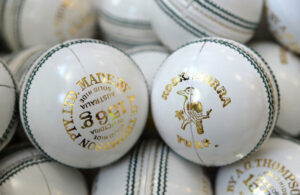
- Reduced Wear and Tear: Because two balls alternate every over, each ball is only used for a maximum of 25 overs in a standard 50-over innings.
- Perpetual Hardness: A ball rarely reaches the extreme state of deterioration required to initiate reverse swing at normal bowling speeds within just 25 overs.
- The Death of the Rough Side: Without an intensely weathered side, the critical boundary layer asymmetry never forms.
2. Sandpaper Gate and the Paranoia of Ball Tampering
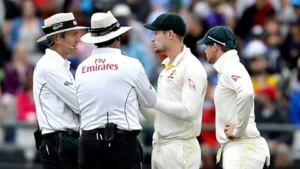
Historically, the natural wear of a cricket ball was accelerated by throwing it into the abrasive pitches of the subcontinent or letting it strike the rough square. However, high-profile controversies—most notably Australia’s “Sandpapergate” scandal in 2018—thrust ball maintenance under an unforgiving microscope. Today, players operate under immense paranoia. The fear of being accused of ball tampering means fielders are hesitant to let the ball bounce naturally on the square or use aggressive drying tactics, inadvertently keeping the ball far too pristine for reverse swing to surface.
“The current rules have completely eliminated reverse swing from the 50-over game. You have two brand new balls; it stays hard, it doesn’t get scuffed up, and it simply doesn’t reverse.”
— Paraphrased from frequent commentaries by modern fast-bowling legends.
3. Pristine, Lush Outfields
Modern cricket stadiums are marvels of agricultural engineering. Outfields are meticulously manicured, lush, and carpeted with soft grass to prevent player injuries during diving. While this is great for player longevity, it is a nightmare for fast bowlers. In the 1980s and 1990s, dry, abrasive outfields acted like sandpaper on the leather ball. Today, a ball can travel to the boundary ten times on a lush outfield and return to the bowler looking virtually untouched.
The Structural Impact Across Different Formats
The narrative of how reverse swing disappears in modern cricket shifts slightly depending on the format of the game being played. Let’s look at the contrast between short-form and long-form cricket.
- Twenty20 International (T20I) Cricket: In T20Is, a single ball is used for only 20 overs. Because it never crosses the 30-over threshold where natural decay sets in, true reverse swing is practically non-existent in the shortest format, forcing bowlers to rely heavily on variations like cutters and knuckleballs.
- Test Match Cricket: Test cricket remains the last sanctuary for reverse swing because a single ball must be used for a minimum of 80 overs. However, even in Tests, ultra-protective ball-tampering monitoring and softer pitch characteristics mean it takes much longer for the ball to behave abnormally compared to previous eras.
The Consequences for Bowlers: A Deepening Imbalance
When reverse swing vanishes, cricket loses its equilibrium. Modern bats are thicker, boundaries are shorter, and pitches are often rolled flat to favor high-scoring entertainment. Reverse swing was the ultimate equalizer; it allowed a fast bowler to remain an attacking threat even on a dead surface in the heat of the afternoon. Without it, bowlers have become defensive containment machines, forced to bowl wide lines, slower balls, and bouncers simply to limit the damage.
Conclusion: Can We Bring Back the Art?
Understanding how reverse swing disappears in modern cricket highlights a systemic shift toward a batsman-dominated sport. Between the two-ball mandate in ODIs, perfectly manicured outfields, and rigid monitoring, the environmental alchemy required for a ball to reverse has been engineered out of existence. To salvage this beautiful, scientific art form, cricket’s governing bodies may need to reconsider ball regulations, perhaps returning to a single ball per innings or introducing alternative leather treatments that allow natural degradation without tampering.
The vanishing act of the reversing ball reminds us that cricket is at its best when it provides a fair contest between bat and ball. Until structural changes are made, the sight of a roaring fast bowler shattering stumps with an old ball tracking sideways will remain a nostalgic memory captured in archival footage.
What is your take on the state of modern fast bowling?
Should the ICC scrap the two-ball rule in ODIs to bring back the magic of reverse swing? Let us know your thoughts in the comments below, and share this article with your fellow cricket fanatics!
Frequently Asked Questions
Why don’t bowlers use saliva on the cricket ball anymore?
The ICC permanently banned the use of saliva on the ball to eliminate health risks and prevent transmission of viruses. Bowlers are now permitted to use only natural sweat to polish the shiny side of the ball.
Can you reverse swing a brand-new cricket ball?
No. Reverse swing fundamentally relies on a stark physical contrast between a highly deteriorated, rough side and a well-preserved, smooth side. A new ball has uniform lacquer and smooth leather on both halves, meaning it can only produce conventional swing.
At what speed does a ball start to reverse swing?
While subtle reverse can happen at medium paces, true, late, and destructive reverse swing generally requires high speeds—typically above 85 mph (136 kph). Higher velocities amplify the pressure differentials across the two hemispheres of the ball, forcing sharper late deviation.
Why is reverse swing harder to achieve with a white ball than a red ball?
The white ball is coated with a synthetic polyurethane paint to keep it visible under lights, which behaves differently than the naturally dyed leather of a red ball. Additionally, because two white balls are used per innings in ODIs, each ball only undergoes 25 overs of wear, stopping it from reaching the advanced age required for reverse.