

Different types of Pitches In Cricket Explained
Today we understand different types of pitches and their characters To truly dominate the game, you must learn to read the 22 yards before the first ball is even bowled.
The Science of the Surface
A cricket pitch is an evolving ecosystem influenced by soil composition (clay content), moisture levels, rolling techniques, and overhead weather conditions. How these elements interact determines whether a track becomes a batter’s paradise or a bowler’s playground. Let’s dissect the four primary types of pitches found across the cricketing world.
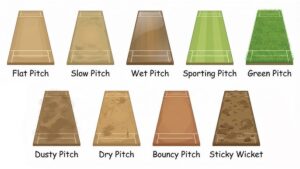
1. The Hard, Flat Track (The Batter’s Paradise)
Characterized by a dense, heavily rolled clay base and baked under prolonged sunshine, hard pitches are common in Australia and modern limited-overs venues globally. With minimal moisture and virtually no grass, these surfaces offer consistent, predictable pace and true bounce.
Because the ball comes onto the bat beautifully without deviating, batters can trust the bounce and play through the line of the ball with maximum freedom. However, the sheer hardness allows explicit fast bowlers to extract steep, uncomfortable bounce to test a batter’s technical resolve.
Capitalize on the true bounce by playing front and back-foot shots with high intent. Watch for the heavy short ball, but trust your horizontal-bat shots like the pull and cut.
Pacers must target the “test match length” or use raw pace and bouncers to push batters back. Spinners must rely heavily on flight variations, subtle changes of pace, and defensive lines.
2. The Soft / Sticky Wicket (The Test of Attrition)
Often encountered in overcast, damp regions or early in the season, soft pitches retain underlying moisture due to insufficient rolling or lack of sunlight. When moisture is trapped beneath the surface, the ball loses significant velocity upon pitching, creating a “two-paced” nature where some deliveries stop while others slide through.
Timing becomes a logistical nightmare for batters, as the ball rarely arrives when expected. Conversely, the dampness allows the seam and leather to grip the surface, offering natural variations without requiring massive physical effort from the bowler.
Exercise extreme patience. Abandon pre-meditated shots, play with soft hands, and wait for the ball to arrive. Avoid hitting on the rise; prioritize playing directly under your eyes.
Seamers should utilize fingers-up variations and off-cutters to exploit the tackiness. Spinners can extract sharp, slow turn, making over-spin highly effective.
3. The Green Seamer (The Fast Bowler’s Dream)
Visually striking and feared by top-order batters, a green pitch features a noticeable covering of live grass. Common in countries like England, New Zealand, and South Africa, the grass serves a dual purpose: it binds the surface together and acts as a friction agent against the ball’s stitched seam.
As the ball lands on the grass, the seam undergoes erratic, unpredictable lateral movement (seam deviation). Combined with early-morning moisture or atmospheric humidity, the ball can swing through the air and zip off the deck, making survival the primary objective for the batting side.
Leave aggressively outside the off-stump to force the bowler into your pads. Play with a vertical bat, avoid chasing wide deliveries, and accept that you will be beaten occasionally.
Make the batter play. Target the “corridor of uncertainty”—just outside off stump—on a full-to-good length. Let the pitch do the work; avoid over-extracting or bowling too short.
4. The Dusty Wicket (The Spin Paradise)
Prevalent across the Indian subcontinent, dusty pitches are characterized by a low-clay, high-silt soil composition that dries rapidly under intense heat. The lack of moisture causes the topsoil to crumble, creating a abrasive, cracked surface covered in fine dust.
As the match progresses, the ball acts like sandpaper against the dry dirt, tearing chunks out of the surface. This produces explosive turn, variable low bounce, and reverse swing for fast bowlers who can deliberately scuff the ball.
Do not stay anchored to your crease. Use decisive footwork—either coming down the track to smother the spin before it lands, or retreating deep inside the crease to play late. Use the sweep shot as a tactical release mechanism.
Spinners should target the rough patches. Maintain a high revolutions-per-second count on the ball, vary your release angles, and allow the natural degradation of the pitch to deceive the batter.
Quick Reference: Different Types ypes of Pitch Behavior at a Glance
| Pitch Type | Primary Feature | Key Beneficiary | |
|---|---|---|---|
| Hard / Flat | True bounce, high pace | Stroke-playing Batters | |
| Soft / Sticky | Tacky surface, sluggish bounce | Medium Pacers & Spinners | |
| Green | Grass cover, high moisture | Swing & Seam Bowlers | |
| Dusty | Dry, cracked, crumbly topsoil | Spin Bowlers |
Conclusion
In cricket, the highest-performing players aren’t necessarily those with the prettiest textbook shots or the fastest run-ups—they are the ones who assess their environment fastest. The pitch is an active participant in every tactical equation. By recognizing these four foundational surfaces early, adjusting your technical setups, and altering your risk assessment, you turn a volatile environment into a calculated advantage.