

Why Is a Cricket Pitch 22 Yards Long? Explained
Every cricket fan knows the magic number: 22 yards. It is the sacred distance in the pitch that dictates the battle between bat and ball, whether you are watching a Test match at Lord’s or playing a casual game in your backyard. But have you ever paused to ask why? Why didn’t the game’s founders settle on a clean 20 yards, or a nice round 25?
This comprehensive guide breaks down the historical origin of the cricket pitch, the mathematics behind its measurement, and how this historic distance continues to shape tactical gameplay in the modern era.
The Historical Origin: Gunter’s Chain and Imperial Measures
To understand why a standard cricket pitch measures exactly 22 yards, we have to travel back to 17th and 18th-century England. Long before the Marylebone Cricket Club (MCC) codified the official laws of the game, cricket was a rustic sport played across British pastures and public commons.
When the earliest formal rules were drafted in 1744, lawmakers didn’t pull the number 22 out of a hat. Instead, they relied on the standard tool used by every English surveyor, farmer, and landowner at the time: Gunter’s Chain.
Read more:
https://cricalien.com/mastering-cricket-bowling-variations-the-ultimate-guide-to-deceiving-batters/
What is Gunter’s Chain?
Invented by English clergyman and mathematician Edmund Gunter in 1620, this actual metal chain was the gold standard for measuring land.
- A single Gunter’s Chain measured exactly 22 yards from end to end.
- The chain was comprised of 100 individual links.
- This length made land math incredibly simple: 10 square chains equaled exactly 1 acre of land.
Because every local cricket coordinator and farmer already possessed a Gunter’s Chain to mark out property lines, it became the most practical tool for measuring a cricket field. Instead of counting out individual feet or paces, two stumps were simply hammered into the ground at either end of one fully stretched chain.
By the time the imperial system faced global modernization, the 22-yard distance was so deeply woven into the fabric of the sport that changing it would have completely disrupted the game’s competitive dynamics.
Anatomy of a Cricket Pitch: Exact Dimensions Explained
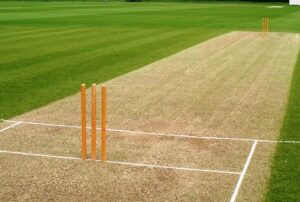
While the total distance between the two sets of wickets is 22 yards (which converts to 66 feet or 20.12 meters), the actual playable area involves several other crucial markings. Understanding these numbers is essential for recognizing how modern umpires officiate no-balls and wides.

As illustrated above, the 22-yard metric measures the distance specifically between the bases of the wickets. Let’s break down the other vital dimensions that groundskeepers paint onto the turf:
- The Popping Crease (Batting Crease): Painted 4 feet (1.22 meters) in front of the bowling crease. This is the line a batsman must keep their bat or foot behind to avoid being stumped or run out. It is also the line a bowler must not overstep to avoid calling a front-foot no-ball.
- The Total Width: The flat pitch area extends 10 feet (3.05 meters) wide. The central playing strip is meticulously rolled and cut, while the outer edges slowly blend back into the outfield grass.
- The Bowling Crease: A line 8 feet, 8 inches (2.64 meters) long, with the three stumps centered right in the middle.
Note on Internal Linking: If you are a cricket coach or player setting up a local field, having a precise understanding of crease lines is vital. You can explore our upcoming Step-by-Step Guide to Pitch Crease Markings for a detailed breakdown of how to paint these lines accurately.
The Physics of 22 Yards: Why it Creates Perfect Balance
What started as an agricultural convenience turned out to be a stroke of genius for the physics of sports. The 22-yard length creates a fascinating, razor-thin margin of error between a professional fast bowler and an elite batsman.
Reaction Time Calculations
Consider an elite fast bowler delivering a cricket ball at 90 mph (145 km/h).
- At that velocity, the ball travels the 22-yard distance in roughly 0.4 to 0.5 seconds.
- Within that half-second window, a batsman’s brain must track the ball’s release, calculate its trajectory, anticipate the bounce off the turf, decide on a shot selection, and physically swing the bat into position.
If the cricket pitch were shortened to 18 yards, fast bowling would become incredibly dangerous, giving batsmen virtually zero reaction time to protect themselves or play a controlled shot. Conversely, if the distance were extended to 25 yards, the ball would lose too much kinetic energy and bounce too low by the time it reached the batsman, stripping fast bowlers of their primary weapons and making the game predictable and boring.
Read more:
https://cricalien.com/who-is-matt-boyle-the-rising-star-of-new-zealand-cricket/
The Role of “Drift and Dip”
For spin bowlers, this exact length provides the perfect airtime required to generate aerodynamic drift (the lateral movement of the ball through the air) and dip (the sudden downward drop caused by topspin). The 22-yard strip gives the ball just enough time to curve through the air before striking the dirt, allowing clever spinners to deceive a batsman before the ball even hits the ground.
How a Cricket Pitch Changes Over Time
A natural turf surface is a living, breathing thing. Unlike a rigid synthetic surface, a traditional clay and grass turf evolves significantly over the course of a multi-day match.
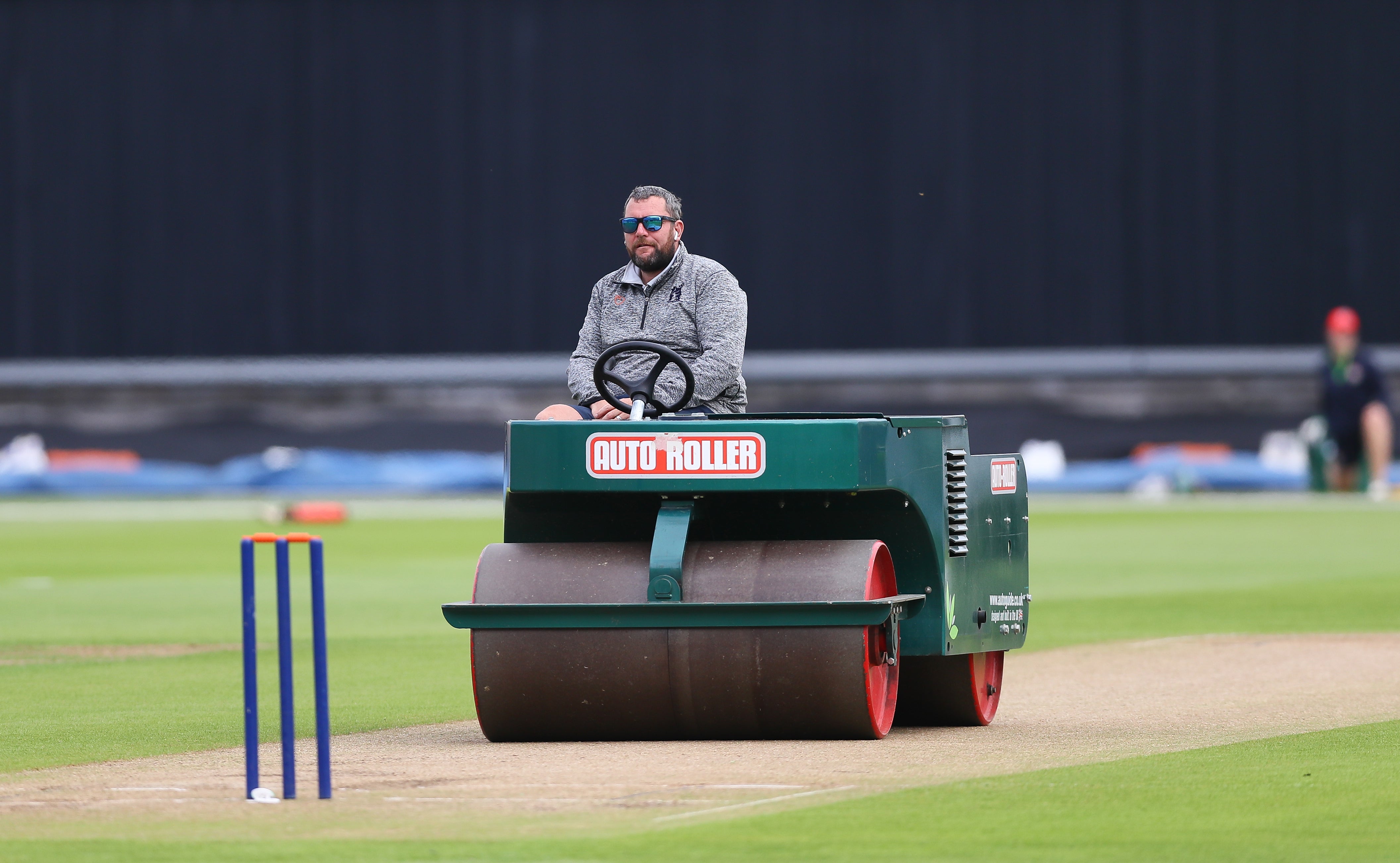
Groundskeepers use heavy rollers to flatten the underlying clay particles, creating a hard, dense surface that offers true bounce on day one. However, as the game progresses, the environment takes over:
| Match Phase | Pitch Condition | Impact on Play |
|---|---|---|
| Day 1 (Fresh) | Contains slight moisture; green grass coverage. | Provides seam movement for fast bowlers; easy, predictable bounce for batsmen. |
| Day 3 (Wearing) | Moisture dries up completely; surface begins to crack. | The ball starts to behave unpredictably; friction increases spin options. |
| Day 5 (Aged) | Cracks widen; footmarks create rough, dusty patches. | Extreme spin and uneven bounce make batting highly difficult; favors spin bowlers. |
Because the physical characteristics of the clay change so drastically, teams must carefully study the surface before the game begins to determine whether to bat or bowl first after winning the coin toss.
Frequently Asked Questions (FAQs)
1. Is a cricket pitch the same length for kids and junior matches?
No. To accommodate physical growth and lower throwing strength, junior cricket playing strips are shortened. For example, Under-11 matches typically use a length of 16 to 18 yards, while Under-13 competitions generally move up to 20 yards. Full 22-yard setups are introduced around the Under-15 level.
2. Why isn’t the distance measured in meters or feet officially?
While metric equivalents exist (20.12 meters), cricket fiercely preserves its historical terminology. The International Cricket Council (ICC) continues to define the game’s framework using standard imperial terms to respect the historical roots established in English law.
3. How wide is an official cricket pitch?
The flat, prepared surface measures 10 feet (3.05 meters) wide. However, the critical scoring action takes place within the width of the bowling crease, which is exactly 8 feet, 8 inches wide.
4. What type of soil is used to construct a professional pitch?
Professional pitches require specific heavy clay soils with a minimum clay content of 30% to 35%. This high clay content ensures the surface can be rolled tightly enough to withstand days of pounding from fast bowlers without crumbling instantly.
5. Why is cricket pitch 22 yards?
Cricket pitch is 22 yards long because this measurement became a standard in early cricket history. It gives a fair balance between batsman and bowler. Today, all official cricket matches follow this length.
6. Why is 22 yards a chain?
A chain is an old measuring unit used in England. One cricket pitch length was equal to one chain, which is 22 yards. That is why 22 yards became connected with cricket.
7. How big is 22 yards?
22 yards is equal to 66 feet or around 20.12 metres. It is the exact length of the cricket pitch from one wicket to another.
8. What is the difference between a 24 and 22 chain?
A 22-chain is an old measurement equal to 22 yards, while a 24-chain would be longer. In cricket, the standard used is 22 yards.
9. Why is it called a chain?
It is called a chain because old land measurements used a physical measuring chain. One chain was traditionally equal to 66 feet, which matches the cricket pitch length.
Conclusion: The Legacy of 22 Yards
What began as a simple convenience tied to a 17th-century surveyor’s tool has stood the test of time to become one of the most balanced dimensions in all of world sports. The 22-yard cricket pitch provides a flawless platform where raw speed, delicate spin, and lightning-fast human reflexes can compete on totally equal terms.
Understanding these dimensions gives you a much deeper appreciation for the tactical nuances of the game, whether you are analyzing a spinning delivery or evaluating a bowler’s foot faults.