

What is Meant By Reverse Swing and Why It’s So Tough to Master
Few sights in cricket match the sheer drama of a fast bowler steaming in with an old, battered leather ball and making it late-shatter the stumps against all logical expectations. For decades, batters have been bamboozled by deliveries that inexplicably deviate toward the shiny side instead of away from it. But what is meant by reverse swing, and what makes this phenomenon the ultimate holy grail for fast bowlers? Unlike conventional movement, which relies on a pristine new ball, mastering this late-tailing dark art requires a perfect alignment of atmospheric conditions, pristine ball maintenance, aerodynamic thresholds, and millimeter-precise physical execution.
Whether you are an aspiring quick trying to add a lethal weapon to your arsenal or a passionate fan trying to decode the physics behind the commentary, understanding the intricacies of this craft will change how you look at the game. Let’s dive deep into the fascinating world of aerodynamic anomalies and look at why it remains one of the toughest skills to conquer in modern sports.
What is Meant by Reverse Swing?
To understand reverse swing, we must first contrast it with conventional swing. When a cricket ball is brand new, bowlers tilt the primary seam at an angle (roughly 15 to 20 degrees) toward the slips or leg side. Air travels faster over the smooth side of the ball, while the raised seam “trips” the air on the opposite side into a turbulent flow. This pressure differential creates a lateral aerodynamic lift force, steering the ball in the direction the seam is pointing.
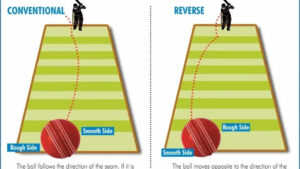
However, as the match progresses, the ball deteriorates. When the bowling side meticulously shines one hemisphere while letting the other become deeply scuffed, scratched, and rough, a threshold is crossed. This transition is exactly what is meant by reverse swing: a physical phenomenon where an old cricket ball deviates in the exact opposite direction of the seam orientation, moving toward its smooth, polished side rather than the rough side.
The Dark Science of Reverse Swing: Fluid Dynamics Explained
Why does the ball turn traitor on the laws of conventional physics? The answer lies deep within fluid mechanics and the behavior of boundary layers. According to aerodynamic research published on authority platforms like ResearchGate, a cricket ball moving through the air generates a microscopic layer of air around its surface called the boundary layer.
In reverse swing, the ball has usually surpassed 30 to 40 overs of wear. Because the “rough” side is now drastically cratered and fibrous, it trips the air into a chaotic, turbulent state almost instantly at the front of the ball. This heavily turbulent boundary layer thickens rapidly and loses energy, causing it to separate from the surface prematurely. Meanwhile, the polished, shiny side retains a thinner, more cohesive turbulent flow that clings to the ball’s contour further around the back before separating.
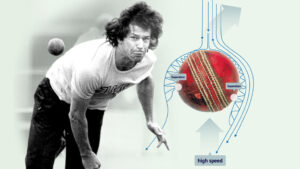
By Bernoulli’s principle, the delayed separation on the shiny side creates a localized low-pressure zone. The ball is consequently sucked toward the shiny side—defying the physical trajectory a batsman has spent a lifetime training to read.
Why Reverse Swing is So Incredibly Tough to Master
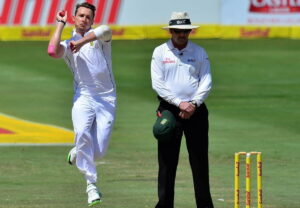
While the theoretical physics might make sense on paper, executing this on a live cricket pitch is a monumentally difficult challenge. It is the reason why out of thousands of first-class fast bowlers across history, only a select handful—like Wasim Akram, Waqar Younis, and Dale Steyn—are considered true masters of the craft. Here is a breakdown of why understanding what is meant by reverse swing is vastly different from actually delivering it.
1. The Extreme Pace Threshold
Conventional swing can be achieved at modest medium-fast paces (around 80–85 mph or 130 km/h). Reverse swing, however, behaves like a sleeping beast that only wakes up under immense kinetic energy. Wind tunnel studies indicate that for a ball to reliably reverse, the bowler must cross a critical Reynolds number threshold. In practical terms, this means delivering the ball at speeds exceeding 85 mph (137 km/h), with maximum movement unlocked at speeds north of 90 mph (145 km/h). Maintaining that level of raw velocity while keeping control over line and length is physically punishing.
2. The Art of Flawless Ball Maintenance
A bowler cannot reverse a ball alone; it requires a collective team effort and strict discipline. The fielding side must treat the ball with absolute precision:
- One-Sided Isolation: Every single fielder must ensure that moisture, sweat, and mint-infused saliva are strictly applied to only one hemisphere.
- Protecting the Scuffs: The opposite side must remain completely dry and be allowed to repeatedly slam against the hard, abrasive pitch to build up deep surface roughness.
- The Mud Factor: If an erratic fielder accidentally shines the rough side or lets it get wet, the delicate asymmetry required for reverse swing vanishes instantly.
3. Millimeter-Perfect Release and Wrist Position
To get the ball to move late, the bowler’s release must be flawless. If the seam wobbles even slightly in mid-air, the air flow becomes symmetrical on both sides, destroying the pressure differential. Master bowlers impart a clean, back-spinning axis to create gyroscopic inertia, stabilizing the seam throughout its 22-yard flight path.
“Whenever I practice in the nets, I practice each and every situation – be it with the new ball, be it with the old ball… Fast bowling is an art, and controlling an old ball requires total mastery over your wrist position.”
— Jasprit Bumrah, Modern Fast Bowling Icon
How Reverse Swing Redefines the Battle Between Bat and Ball
When a bowler successfully unlocks reverse swing, it completely flips the traditional balance of power in cricket. For a comprehensive look at how tactical bowling shifts across different match phases, read our guide on Modern Cricket Bowling Tactics or explore our detailed breakdown on How Subcontinent Pitches Age.
To successfully combat reverse swing, a batsman must throw out their traditional textbook and adopt a highly specialized approach:
- Watching the Shiny Side: Batsmen must intensely scrutinize the ball in the bowler’s hand prior to release, trying to spot which side is flashing white or reflective to predict the direction of the upcoming inward or outward tail.
- Suppressing the Backlift: Because reverse swing occurs incredibly late in the ball’s trajectory, batsmen must lower their backlift to ensure their bat can come down in time to stop a late-dipping toe-crusher.
- Playing Late and Low: Committing to a front-foot drive too early against a reversing ball is tactical suicide. Batsmen must play directly under their eyes and treat the ball as if it will move at the very last microsecond.
The Legends Who Pioneered and Mastered the Art
The history of reverse swing is steeped in mystery, intrigue, and tactical genius. Born on the dry, abrasive domestic pitches of Pakistan, the craft was pioneered by Salim Mir and Sarfraz Nawaz in the late 1970s. Nawaz passed the knowledge to Imran Khan, who transformed it into a devastating systemic weapon for the national team.
By the 1990s, the legendary duo of Wasim Akram and Waqar Younis—affectionately dubbed the “Sultans of Swing”—took the cricketing world by storm. They proved that reverse swing wasn’t just a defensive trick to dry up runs on flat, lifeless subcontinental decks, but an ultra-aggressive attacking option capable of clean-bowling world-class top orders at terrifying speeds.
Summary: The Perfect Storm of Physics and Human Skill
In conclusion, understanding what is meant by reverse swing requires looking past the surface of a standard cricket match and appreciating the intricate dance of fluid dynamics, team discipline, and mechanical excellence. It remains an incredibly tough skill to master because it demands hyper-elusive conditions: raw pace, pristine asymmetric ball maintenance, immaculate wrist stability, and a deep psychological understanding of the batsman’s vulnerabilities. When all these pieces fall into place, it results in arguably the most unplayable weapon in all of modern sport.
Read more
https://cricalien.com/who-will-be-next-fab-four-in-world-cricket-predict-the-future-icons/
https://cricalien.com/top-5-fastest-over-in-cricket-history-ultimate-pace-men/
https://cricalien.com/the-rise-of-japan-cricket-how-a-baseball-nation-is-building-a-t20-powerhouse/