

Seam vs Swing Bowling Difference in Cricket Explained
For anyone watching a fast bowler steam in from the boundary, the sight of a cricket ball deviating late can be absolutely mesmerizing. But to the untrained eye, all fast-bowling movement looks identical. Commentators frequently toss around technical phrases, leaving many fans wondering: what exactly is the seam vs swing bowling difference in cricket? While both techniques are designed to deceive the batter by altering the ball’s trajectory, they rely on entirely different physics, physical conditions, and biological skills.
Understanding these subtle nuances will completely change how you watch a Test match or a T20 showdown. Whether you are an aspiring fast bowler trying to master your release or a fan wanting to out-smart your friends in the commentary box, this comprehensive guide breaks down the science, the strategies, and the key differences between seam and swing bowling.
What is Swing Bowling? (Movement Through the Air)
Simply put, swing bowling is the art of moving the cricket ball through the air *before* it hits the pitch. The deviation happens during flight, giving a sharp batter a brief window to spot the curve, though late swing remains almost impossible to play safely.
The Aerodynamics of Swing
Swing bowling relies heavily on fluid dynamics—specifically, Bernoullis principle and boundary layer physics. A cricket ball features a raised primary seam stitched around its equator. As a bowler polishes one side of the leather while letting the other side naturally roughen, they create an aerodynamic asymmetry.
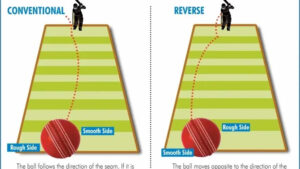
When the ball travels through the air, air flows faster over the smooth, shiny side (creating low pressure) and encounters turbulence on the rough side (creating high pressure). This pressure imbalance forces the ball to glide sideways, moving away from or toward the batter.
Types of Swing Bowling
- Inswing: The ball curves into the right-handed batter’s body mid-flight. Bowlers achieve this by angling the seam slightly toward fine leg and keeping the shiny side facing the leg side.
- Outswing: The holy grail of fast bowling. The ball drifts away from the right-handed batter toward the slip cordon. The seam points toward first slip, with the shiny side facing the off side.
- Reverse Swing: A lethal phenomenon that occurs later in an innings when the ball becomes heavily weathered and scuffed. Through intricate weight distribution and a turbulent boundary layer, the ball unexpectedly swings *toward* the shiny side rather than away from it, completely baffling the batter.
What is Seam Bowling? (Movement Off the Pitch)
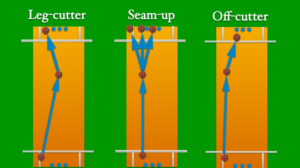
If swing bowling is theater in the air, seam bowling is chaos off the turf. Seam bowling refers to a delivery where the ball travels straight through the air but drastically changes direction the split-second it lands on the pitch.
The Mechanics of Seam Movement
To bowl an effective seam delivery, the bowler must release the ball with a vertical, upright seam position. The goal is to make the hard leather seam strike the pitch directly upon landing.

Because the pitch is uneven and the seam forms a raised ridge around the ball, striking the turf squarely creates random friction. If the seam lands at a minute fraction of an angle, it acts like a tiny rudder, violently redirecting the ball to the left or right. Unlike swing bowling, which can be somewhat anticipated by reading the bowler’s wrist layout, seam deviation is highly unpredictable—even for the person delivering the ball.
Key Variables for Seam Bowlers
- Pitch Hardness and Grass Coverage: Green, hard pitches provide a reactive canvas. The grass creates structural ridges that clip the seam, exaggerating the sideways movement.
- Imperfect Pitch Indentations: Cracked or deteriorating pitches (frequent on Days 4 and 5 of a Test match) create uneven pockets. Landing a seam inside a microscopic pitch fracture leads to extreme, unplayable deviation.
Seam vs Swing Bowling Difference in Cricket: Head-to-Head Comparison
To crystallize your understanding, let’s analyze the fundamental parameters where these two disciplines split paths.
| Feature | Swing Bowling | Seam Bowling |
|---|---|---|
| Where Movement Occurs | Entirely in the air, before landing. | Off the pitch, immediately after landing. |
| Primary Catalyst | Atmospheric conditions, air pressure, and ball shine. | Pitch texture, hardness, and vertical seam landing. |
| Ball Age Dependency | Easiest with a brand-new ball (or an old ball for reverse swing). | Effective across any age, |
| Predictability | Slightly predictable; batters can track the seam angle through the air. | Completely unpredictable; |
“Swing bowling tests a batter’s technique and judgment in the air, but an elite seam bowler hunting a green pitch tests a batter’s pure reflexes.”
Ideal Conditions for Both Styles
Environmental factors dictate which style will dominate on any given match day. Fast bowlers constantly monitor weather indicators and pitch moisture like meteorologists.
The Perfect Swing Environment
Swing bowlers thrive under overcast skies. Heavy cloud cover preserves ambient humidity, cooling the air and stabilizing the boundary layers around the ball, enabling sustained swing. Additionally, lush outfields keep the ball clean, allowing fielding sides to build a brilliant shine on one half of the ball for a longer duration.
The Perfect Seam Environment
Seam bowlers prefer bright sunshine paired with a hard, grassy wicket. The heat dries out the surface, making it solid and bouncy. When a fast bowler thumps a rock-hard cricket ball into an equally rigid pitch, the energy transfer causes maximum jagged movement off the surface.
Icons of the Game: Legends of Seam and Swing
To truly grasp the seam vs swing bowling difference in cricket, you only need to watch archival footage of the game’s greatest icons execution styles.
Masters of the Curved Air
Pakistan’s legendary duo, Wasim Akram and Waqar Younis, redefined conventional and reverse swing bowling, devastating batting line-ups with pinpoint yorkers that curved violently late. Similarly, England’s James Anderson solidified his legacy as one of the most prolific fast bowlers in history, utilizing pristine wrist positions to control outswing and inswing at will.
Legends of the Jagged Seam
Australia’s Glenn McGrath rarely swung the ball vastly; instead, he targeted the exact same microscopic spot on the pitch repeatedly, letting the seam deviate subtly to clip the outside edge. South African speedster Dale Steyn combined blistering pace with lethal seam presentation, while India’s Jasprit Bumrah utilizes a unique release angle to extract sharp seam movement off seemingly flat tracks.
Conclusion & Next Steps
While the seam vs swing bowling difference in cricket boils down to air vs. pitch, mastering either requires immense physical conditioning, precise finger positioning, and a deep tactical mind. Swing bowling lures batters into false drives through beautiful visual curves, whereas seam bowling shatters defenses with sudden, unadulterated deviation off the dirt.
The next time you settle in to watch a match, look closely at the bowler’s wrist at the point of release. Is the seam angled to catch the wind, or is it perfectly upright to strike the turf? Recognizing this distinction transforms your viewing experience from simple spectatorship into true technical appreciation.
Read more :
https://cricalien.com/top-5-fastest-over-in-cricket-history-ultimate-pace-men/
https://cricalien.com/who-will-be-next-fab-four-in-world-cricket-predict-the-future-icons/