

Why Ball Swing More in England? The Science Explained
why ball swing more in England compared to the dry heat of Australia or the dust-heavy pitches of India?

While casual fans often attribute this entirely to “cloud cover,” the actual explanation is a fascinating blend of fluid dynamics, distinct atmospheric physics, and precision manufacturing. In this deep-dive guide, we will unravel the hard scientific truths and environmental secrets behind cricket’s greatest overhead mystery.
Table of Contents
1. The Anatomy of Swing: How Does It Work?
Before understanding why the UK is the ultimate paradise for pace bowlers, it is essential to understand the basic mechanics of aerodynamic swing.
When a fast bowler releases a cricket ball, air flows over both sides of its surface. As the ball progresses down the pitch, the side with the prominent, raised seam creates a split in the airflow.
- Conventional Swing: On a relatively fresh ball, the bowler polishes one side meticulously while letting the other roughen up naturally. The air traveling across the rough hemisphere becomes turbulent and breaks away later, whereas the air flowing over the smooth side remains laminar (smooth) and detaches earlier. This pressure imbalance generates lateral aerodynamic force, moving the ball toward the rough side.
- The Boundary Layer: This thin layer of air clinging directly to the surface of the ball is highly sensitive to external variables. Tiny fluctuations in humidity, temperature, and surface construction completely dictate when and how that boundary layer transitions from laminar to turbulent.
2. Atmospheric Conditions in the UK
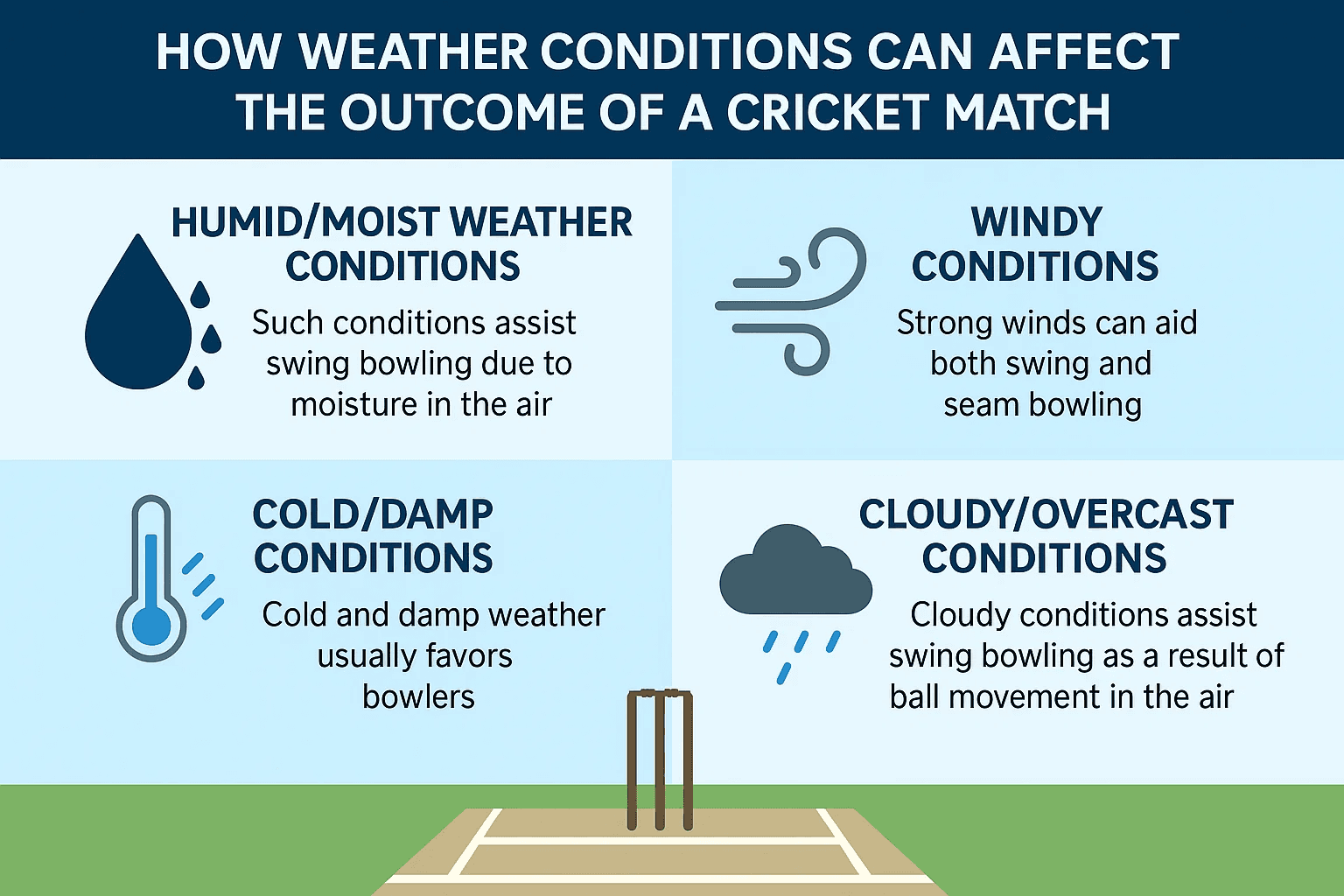
If you ask any seasoned opening bowler what conditions they pray for, the answer is always identical: “An overcast morning in Leeds or London.” The maritime climate of the United Kingdom acts as a natural laboratory perfectly calibrated to optimize fluid movement.
Read more:
https://cricalien.com/how-does-swing-bowling-works-in-cricket/
The Overcast Myth vs. Aerodynamic Reality
For generations, the conventional wisdom was that heavy, humid air is “thicker,” allowing the ball to push against it and swing more. However, aerodynamicists have proven that humid air is actually less dense than dry air because water molecules (H₂O) weigh less than nitrogen (N₂) and oxygen (O₂) molecules.
So, what is actually happening?
When England experiences heavy cloud cover, solar radiation is blocked from hitting the ground directly. This dramatically cuts down on thermal convection currents—upward columns of warm air rising off the warm turf. In a hot, dry climate like Australia, these chaotic thermal currents disrupt the smooth, laminar boundary layer around a flying cricket ball, killing its movement early.
Read more:
https://cricalien.com/who-is-matt-boyle-the-rising-star-of-new-zealand-cricket/
In contrast, England’s stable, cool, and damp air layers allow the boundary layer to remain perfectly undisturbed, keeping the airflow clean until the pressure differential acts on the seam.
3. The Weapon of Choice: Why the Dukes Ball Changes the Game
You cannot talk about why ball swing more in England without closely examining the literal engine of that movement: the match ball.
While international cricket matches in Australia, South Africa, and the UAE utilize the machine-stitched Kookaburra ball, and Test matches in India feature the SG ball, England proudly relies on the locally manufactured Dukes ball.
  DUKES BALL (England)         KOOKABURRA BALL (Rest of World)
┌─────────────────────────┐   ┌─────────────────────────┐
│ • Fully Hand-Stitched   │   │ • Machine-Stitched      │
│ • Pronounced, High Seam │   │ • Flatter Seam Profile  │
│ • Deep Grease Infusion  │   │ • Lacquer Coated Finish │
│ • Holds Shape For 60+   │   │ • Flattens Fast (20-30) │
└─────────────────────────┘   └─────────────────────────┘
The difference this structural design makes to swing capability cannot be overstated:
- The Prominent, Hand-Stitched Seam: The Dukes ball features a prominent, six-row hand-stitched seam that stands exceptionally proud. Because it is stitched by hand across the equator, the seam stays rigid and raised far longer than a machine-pressed alternative. This prominent ridge acts as a highly effective aerodynamic rudder, splitting the air cleanly for up to 50 or 60 overs.
- Traditional English Leather & Grease: Dukes uses a specialized bark-tanning process, and the leather is stuffed with natural greases and tallows before being finished. This unique treatment ensures that the ball retains its natural moisture-repelling wax finish longer. A bowler can continuously buff a Dukes ball to a high mirror shine, even on abrasive squares, keeping the laminar side flawlessly smooth for extended spells.
4. The Ground Effect: Outfields and Pitch Moisture
The geography of English cricket venues further multiplies the air-swing factor. Unlike the baking, sun-parched stadiums of the subcontinent, English grounds are situated in lush, highly damp ecosystems.
Moisture Seepage
The water table across major UK cricket grounds—from Trent Bridge to Edgbaston—is remarkably high. Even on bright days, residual moisture continues to evaporate off the live grass blades on the pitch and the surrounding outfield. This continuous micro-evaporation forms an ultra-thin localized moisture canopy directly above the playing square.
Preservation of the Leather
A dry, sandy, or cracked outfield acts like coarse sandpaper, chewing up both sides of a cricket ball within 15 overs. In contrast, the meticulously manicured, lush green outfields of England protect the leather. This structural preservation ensures that the smooth side remains genuinely pristine while the rough side develops a gradual, uniform texture, setting up the ultimate aerodynamic imbalance required for late, wicked swing.
For more technical guides on modifying cricket gear for diverse playing conditions, read our internal guide on Optimizing Equipment Seams for Local Turf Conditions and explore How Pitch Soil Density Alters Bounce and Carry.
5. What the Legends Say: Real-World Testimonials
The historic data fully validates the physics. Legendary fast bowlers have frequently remarked that bowling with a Dukes ball in English conditions feels entirely different from anywhere else on earth.
During a historic Test series tour, all-time great fast bowler James Anderson remarked on the unique home advantage:
“When the lights are on, the air is cool, and you have a fresh Dukes in your hand, you feel entirely in control of the geometry of the game. The ball tracks the air like it’s on a string.”
Statistically, the average swing deviation recorded by ball-tracking technologies at Lord’s and Headingley regularly exceeds 1.8° of lateral movement during morning sessions—nearly double the average lateral movement recorded at venues like the Melbourne Cricket Ground (MCG) or the Narendra Modi Stadium in Ahmedabad.
6. Frequently Asked Questions (FAQs)
The Verdict: A Perfect Equation of Nature and Craft
Ultimately, the reason why ball swing more in England is not down to just one single factor. It is the perfect scientific intersection of a stable, convection-free atmosphere, high localized ground moisture, pristine outfields, and a beautifully hand-crafted Dukes ball designed to cut through the air like a knife.
Are you looking to master your own bowling craft regardless of the weather? Check out the official breakdown of aerodynamic fluid forces on the NASA Glenn Research Center Sports Aerodynamics Page and look through the detailed ball testing standards outlined on the Marylebone Cricket Club (MCC) Laws of Cricket database.
What is your experience? Do you think modern batters will ever completely decode the swinging Dukes ball? Let us know your thoughts in the comments below!