

Ultraedge vs Snicko:Real Difference in Cricket Technology
If you have watched a modern cricket match, you have seen a tight caught-behind appeal go up to the third umpire. The broadcast cuts to a black screen with a jagged line running along the bottom or side, sync-locked alongside a slow-motion video replay. A spike appears, the commentator shouts, “There’s a clear woody noise!”, and the batsman is sent packing.
But when analyzing ultraedge vs snicko, do you actually know which technology is making that critical decision on your screen?
While both systems serve the exact same purpose—detecting whether a cricket ball brushed the bat or pad—the engineering under the hood is entirely different. One is a legacy analog audio system that relies heavily on human interpretation; the other is a highly precise, automated tracking system backed by the International Cricket Council (ICC).
This comprehensive breakdown covers the technical mechanics, fundamental differences, and real-world application of both tools so you can watch your next match like a veteran tactical analyst.
The Evolution of Edge Detection in Cricket
Before the dawn of the Decision Review System (DRS), umpiring mistakes were simply accepted as “part of the game.” If a ball deviated slightly past the outside edge of a batsman’s blade, the on-field umpire had to rely entirely on raw eyesight and instantaneous acoustic hearing amidst a roaring crowd of thousands.
The introduction of television technology began changing this dynamic in the 1990s. Broadcasters wanted to show audiences at home whether an umpire’s decision was right or wrong. This desire to demystify close calls birthed the original Snickometer.
Over the years, as player stakes and broadcast definitions grew exponentially, TV-only gimmicks transitioned into official officiating utilities. Let’s look closer at how these systems operate to understand why the ultraedge vs snicko debate exists today.
What is Snickometer (Snicko) and How Does it Work?
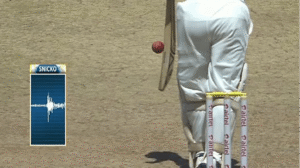
Invented by British scientist Allan Plaskett in the mid-1990s, the Snickometer—commonly known as Snicko—was designed to capture the sound of a ball hitting a cricket bat.
The Technical Setup
Snicko uses a highly sensitive microphone embedded inside one of the stumps at both ends of the pitch. This directional microphone picks up ambient sounds from the center of the wicket and transmits them directly to an audio editing suite in the broadcasting truck.
The Human Calibration
The true limitation of classic Snicko is how it pairs that audio data with broadcast footage:
- An audio engineer isolates the sound frequencies from the stump mic.
- A video editor grabs standard television broadcast video frames (usually captured at 25 to 50 frames per second).
- The technician manually aligns the sound wave overlay onto the video timeline.
Because the video and sound are recorded on separate systems, human error can influence how well they match up. A frame delay can create an illusion that the ball hit the bat when it actually clicked the front pad a split second later. This limitation is why the ICC never fully integrated original Snicko into the official DRS protocol for umpires.
What is Ultraedge and How Does it Work?
As camera tech advanced, a major tech upgrade arrived: Ultraedge. Engineered by tech company Sportcor alongside Hawk-Eye Innovations, Ultraedge is the modern, officially approved iteration of edge detection utilized globally in elite-level cricket.
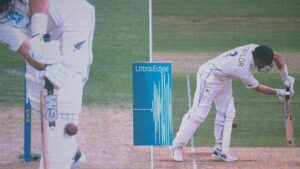
Unlike its predecessor, Ultraedge is not an isolation tool run manually in a television truck. It is a completely integrated hardware and software tracking ecosystem.
Read more:
https://cricalien.com/who-is-matt-boyle-the-rising-star-of-new-zealand-cricket/
Ultra-High-Speed Frame Synchronization
The core upgrade boils down to frame rates. Standard broadcast cameras capture action at 50Hz (50 frames per second). Ultraedge links directly with specialized ultra-slow-motion cameras operating at 300 to 500 frames per second.
Automated Acoustic Distinctions
Instead of using a basic microphone that captures all noises equally, Ultraedge incorporates advanced software filtering algorithms. The system instantly detects the specific acoustic frequencies generated when leather impacts wood, comparing them against the completely different sound signatures created when a ball brushes cotton trousers, leather pads, or scrapes the ground.
Most importantly, the audio data and the high-speed video frames are automatically locked together using a master timecode. There is no technician manually dragging an audio track left or right to make it fit. If the ball is one millimeter away from the bat on the screen when the spike peaks, it is mathematically guaranteed that the sound came from an entirely different source.
Ultraedge vs Snicko: The Main Differences Compared
To simplify the ultraedge vs snicko comparison, look at how the fundamental attributes stack up across both systems:
| Feature | Classic Snickometer (Snicko) | Modern Ultraedge |
|---|---|---|
| Official DRS Approval | No (Used primarily for TV broadcast entertainment) | Yes (Standard across all international and major T20 leagues) |
| Sync Method | Manual alignment by a broadcast technician | Automated frame-by-frame timecode matching |
| Camera Integration | Standard broadcast frame rates (50 fps) | Ultra-high-speed ballistic cameras (300+ fps) |
| Sound Filtering | Basic audio leveling; highly susceptible to crowd noise | Advanced software algorithms that filter out ambient noise |
| Processing Speed | Slow; requires manual compilation and alignment | Near-Instantaneous rendering for the third umpire |
Why Sound Waves Shape Different Spikes
When looking at an ultraedge vs snicko display, third umpires look for specific visual cues in the audio waveform to identify exactly what the ball struck. Different materials produce distinct shapes:
- Ball on Bat: Wood is hard and resonant. When cricket ball leather makes contact with willow, it creates a sharp, immediate, and high-frequency spike that shoots rapidly up and drops just as quickly.
- Ball on Pad/Clothing: Fabrics are dampeners. When a ball brushes a batsman’s trousers or leg guards, the wave signature is much flatter, wider, and smoother, lacking a sharp peak.
- Bat on Ground: When a batsman accidentally strikes the pitch while reaching for a delivery, it produces an erratic, prolonged, and repetitive wave signature because the bat vibrates across the rough turf surface.
Real-World DRS Dilemmas: Why Mistimed Reviews Still Happen
Even with Ultraedge’s automated synchronization, third umpires occasionally run into optical and acoustic illusions that spark debate among players and fans.
Read more:
https://cricalien.com/why-cricket-pitch-22-yards-long/
The “Bat Close to Pad” Conundrum
The most challenging scenario occurs when the bat passes the ball at the exact microsecond it slaps against the front pad. If the sound filter registers a sharp spike, the third umpire must closely inspect whether a tiny gap remains between the ball and the edge of the bat.
In these close scenarios, third umpires cross-reference the Ultraedge feed with Hot Spot—an infrared imaging system that uses thermal cameras to detect heat friction footprints left by ball impacts. If a bright white spot shows up on the edge of the bat right as the Ultraedge spike pops, the batsman is unequivocally out.
If you want to learn more about how modern cricket infrastructure manages these data streams across stadium networks, check out our Comprehensive Guide to Sports Broadcast Networks.
Frequently Asked Questions (FAQs)
1. Why does Australia use Snicko instead of UltraEdge?
Australia often uses Snicko because it is operated by the local broadcaster and is approved for DRS. It provides audio-based edge detection similar to UltraEdge. Both technologies serve the same purpose, but different broadcasters may use different systems.
2. What is the difference between Hawk-Eye UltraEdge and Real-Time Snicko?
UltraEdge combines audio and ball-tracking data through Hawk-Eye technology for more accurate edge detection. Real-Time Snicko mainly uses sound waves from stump microphones. UltraEdge is generally considered more advanced and precise.
3. Which is better, Hotspot or UltraEdge?
UltraEdge is usually considered more reliable because it can detect faint edges using sound analysis. Hotspot uses infrared cameras and may miss edges if conditions are not ideal. Many cricket boards now prefer UltraEdge.
4. Why doesn’t BCCI use Hotspot?
The BCCI stopped using Hotspot mainly because it is expensive and sometimes gives unclear results. UltraEdge has proven to be more consistent and cost-effective. Therefore, most matches in India use UltraEdge.
5. Which company owns Snicko?
Snicko was developed by computer scientist Allan Plaskett. The technology is licensed and used by broadcasters for cricket coverage. It is not owned by Hawk-Eye.
6. Which company Hotspot is best?
In cricket, Hotspot technology is associated with [BBG Sports](https://www.bbgsports.com?utm_source=chatgpt.com). It is one of the leading providers of infrared imaging technology used for edge detection in cricket.
7. What is the Snicko controversy?
Some controversies arose when Snicko showed spikes that players and fans believed came from bat-pad contact, not the ball. This led to debates over DRS decisions. However, officials still consider it a valuable tool.
8. Who owns UltraEdge in cricket?
UltraEdge is owned and operated by [Hawk-Eye Innovations](https://www.hawkeyeinnovations.com?utm_source=chatgpt.com). The system is widely used in international cricket as part of the DRS technology package.
Can Ultraedge differentiate between bat and pad?
Yes. Wood produces a sharp, jagged sound wave that spikes dramatically on the graph. Canvas, leather pads, and clothing create a low, smooth, and rounded wave signature. This clear structural difference helps third umpires distinguish between a real edge and an lbw candidate.
Conclusion: The Verdict on Cricket Technology
When exploring ultraedge vs snicko, it becomes clear that cricket has evolved past simple video replays. While the original Snickometer laid the groundwork for television viewers, Ultraedge took that basic concept and transformed it into a precise scientific tool fit for professional sport. By eliminating manual alignment and adding high-speed frame synchronization, it gives umpires the precision needed to make fair decisions under immense pressure.
The next time you watch a crucial review, keep an eye on the shape of that wave signature—you might spot the edge before the third umpire even delivers their official verdict!
If you want to keep exploring how advanced tech is reshaping modern sports analytics, dive into our Complete Guide to Ball Tracking Systems and Analytics or leave your thoughts on the latest DRS rules in the comments below.