

3 Different Types Cricket Ball in International Cricket Defines the Modern Game
Why does a brand-new ball behave completely differently in London than it does in Mumbai? Why do test captains obsess over keeping one side of the leather perfectly glossy while letting the other side roughen up naturally? In top-tier matches, the answers lie in how the ball is manufactured, the height of its seam, and the specific brand chosen by the home board.
In this expert guide, we will break down the exact construction of the cricket ball in international cricket, analyze how the top three manufacturers alter the dynamics of play, and explore how pitch conditions transform these leather spheres into devastating bowling weapons.
The Anatomy of an Official Cricket Ball in International Cricket
Before diving into the rival brands, it is essential to understand what actually constitutes a regulation match ball. According to the official MCC Laws of Cricket, a men’s international ball must weigh between 5.5 and 5.75 ounces (155.9 to 163.0 grams) and measure between 8.81 and 9 inches (224 to 229 mm) in circumference.
The core of the ball consists of layered cork wrapped tightly in twine, providing its essential bounce and weight. This core is encased in a premium leather jacket, which is split into two or four pieces. The pieces are stitched together with a raised, prominent seam. This seam—consisting of roughly 80 to 90 stitches—acts as a rudder for the bowler, causing the ball to deviate unpredictably when it strikes the pitch.
The Cricket Ball used in International Cricket
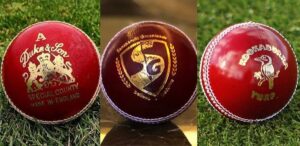
The International Cricket Council (ICC) does not mandate a single brand of ball for all international matches. Instead, the host nation chooses the ball. This freedom has led to the global dominance of three distinct manufacturers, each tailored to local soil and environmental conditions.
1. The Kookaburra (Australia)
The Kookaburra is the most widely utilized cricket ball in international cricket today. It serves as the standard choice for matches played in Australia, New Zealand, South Africa, Pakistan, Sri Lanka, and Zimbabwe.
- Construction: Mostly machine-stitched. The two inner rows of stitching are done by hand, but the outer rows are completed by precision machinery.
- Behavior: It offers excellent, predictable swing for the first 10 to 15 overs when the leather is brand new. However, because the machine-stitched seam sits relatively flat against the leather surface, it tends to flatten out quickly. Once the seam goes flat, bowlers must rely on natural pitch variations or reverse swing.
2. The Dukes (England)
The Dukes ball is the undisputed king of the overcast, lush, and humid conditions found across England and the West Indies.
- Construction: Entirely hand-stitched. The thread holds the six rows of stitching together tightly, creating a proud, highly prominent seam.
- Behavior: Because it is hand-stitched, the seam stays proud for up to 50 or 60 overs. The specialized lacquer used on a Dukes ball allows it to swing for a much longer duration than its competitors, rewarding bowlers who master conventional swing mechanics.
3. The SG (Sanspareils Greenlands – India)
Specially designed to survive the harsh, abrasive, and dry outfields of the Indian subcontinent, the SG ball is the exclusive choice for Test cricket in India.
- Construction: Hand-stitched with an incredibly thick, prominent thread.
- Behavior: The SG ball does not swing as wildly as the Dukes in the opening overs. However, its thick seam gives spinners an incredible grip on dry, turning pitches. Furthermore, because the outer leather scuffs up quickly on abrasive outfields, it becomes the ultimate tool for reverse swing after the 30th over.
For a detailed breakdown of how professional athletes train with these varying specifications, you can check the official performance testing standards on the ICC Official Website.
Color Dynamics of the Cricket Ball in International Cricket
The evolution of the cricket ball in international cricket is directly tied to the commercial evolution of the sport’s formats. Today, international cricket uses three distinct colors depending on the format and time of day.
Featured Snippet Answer: What colors of cricket balls are used in international matches?
International cricket utilizes three distinct colors: Red balls are used for traditional, daytime Test matches; White balls are used for limited-overs cricket (ODIs and T20Is) for maximum visibility under floodlights; and Pink balls are used exclusively for day-night Test matches because they remain highly visible at twilight without decaying too rapidly.
The Traditional Red Ball
Used for daylight Test matches, the red ball is dyed naturally and retains its color well through rough use. It requires regular polishing to maintain a shiny side for conventional swing.
The Limited-Overs White Ball
When day-night One Day Internationals (ODIs) became popular, the red ball proved impossible to see under stadium floodlights. The white ball solved this visibility issue. However, white leather discolors and gets dirty incredibly fast. To counter this, two brand-new white Kookaburra balls are used in ODIs—one from each bowling end—meaning each ball only has to survive 25 overs instead of 50.
The Innovative Pink Ball
Day-night Test matches required a ball that could be seen easily at night but could also last for the grueling 80 overs required by Test match rules. A white ball would get too dirty, and a red ball is invisible under lights. The pink ball features a heavy pigment coat and a clear gloss lacquer that reflects stadium lighting perfectly.
The Science of Swing: Conventional vs. Reverse
Regardless of whether a bowler is using a Dukes or an SG, the aerodynamic principles governing a cricket ball in international cricket remain identical. When a ball is new, bowlers polish one side and leave the other untouched. As the ball flies through the air, air travels faster over the smooth, shiny side than the rough side, creating a pressure differential that forces the ball to curve or “swing” toward the rough side.
However, as the ball ages—especially on abrasive outfields—something magical happens: reverse swing. When the ball becomes incredibly scruffy on one side but remains heavy and smooth on the other, the aerodynamics flip. The ball suddenly curves *toward* the shiny side, completely baffling the batter. Mastering this art requires deep knowledge of how the specific ball brand decays over time.
Frequently Asked Questions about Cricket Balls
Why does England use a different cricket ball than Australia?
England uses the Dukes ball because its hand-stitched, pronounced seam interacts perfectly with the damp air and green pitches found in the UK, encouraging swing. Australia uses the Kookaburra ball because its machine-stitched seam suits the hard, baking pitches down under, offering reliable bounce and carry even when the seam flattens.
How long does a cricket ball last in an international Test match?
According to ICC rules, the fielding captain can request a new ball after 80 overs have been bowled with the current one. However, the fielding side isn’t forced to take it; if the old ball is reversing effectively, a captain might delay taking the new ball.
Why are two white balls used in ODI international cricket?
White leather is highly prone to staining, scuffing, and turning a dull grey color when it hits the pitch and the stadium advertising boards. To ensure the batters and umpires can always see the ball clearly under floodlights, the ICC introduced a rule using two separate balls from each end, ensuring neither ball gets older than 25 overs.
What happens if an international cricket ball goes out of shape?
If a ball passes through an umpire’s gauge and is found to be out of shape, or if the stitched seam splits prematurely, the umpires will replace it. Crucially, they must choose a used replacement ball that matches the exact age and wear condition of the ball being discarded.
Why the Ball Matters
The exact type of cricket ball in international cricket is never just background detail; it completely dictates the tactical blueprint of a match. From the heavily lacquered Dukes that swings around corners in London to the tough SG that withstands the heat of Chennai, understanding the nuances of these cricket balls deepens your appreciation of the world’s most strategic sport.
The next time you watch an international match, look closely at how the bowling side treats the leather. If you want to dive deeper into how elite players counter these balls, check out our comprehensive guide to how international batters read the seam out of a bowler’s hand, or contact our team of coaching experts to find the perfect training equipment for your next season.
https://cricalien.com/different-types-of-pitches-in-cricket-explained/